
Water Heater Flush in Tempe, AZ
Tempe Water Heaters provides water heater flush in Tempe, AZ for homeowners and businesses across Tempe, Arizona and the East Valley. Draining and stirring out the mineral grit that collects at the bottom of a tank is a cheap job, and it's one of the rare maintenance tasks that actually adds years to a heater sitting in Salt River Project water territory.
Flushing addresses calcium carbonate and magnesium scale on the tank floor and on electric elements, brass drain valve obstruction, sediment-induced rumbling and stratification, and the reduced recovery efficiency that scale insulation causes.
Request Your Free Tempe Water Heater Quote
Share a few details about your Tempe water heater and we will send back a quote with no obligation.
What Sediment Does to a Water Heater
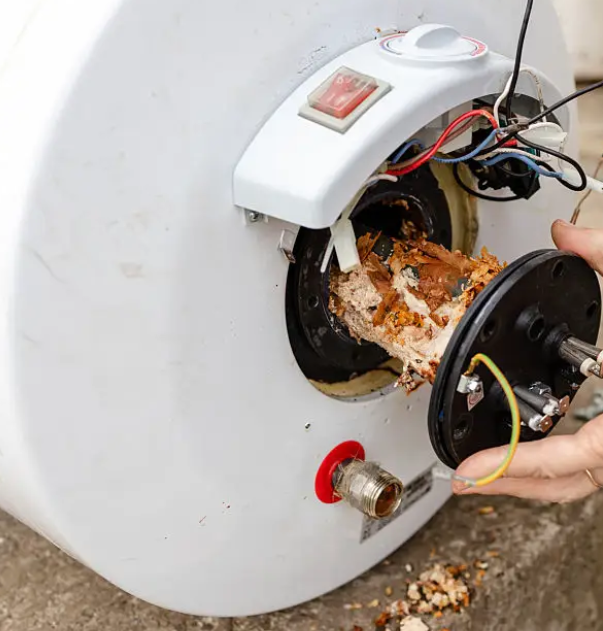
Every gallon heated leaves a little calcium and magnesium behind. After a few Arizona summers of heavy well-and-canal water minerals, that residue bakes into a crusty layer along the tank floor.
- Recovery slows — a gas burner has to push heat through the crust before the water above ever warms up.
- Usable volume shrinks — the grit fills space that should be storing hot water for showers and dishwashers.
- The tank gets loud — pockets of water trapped under the buildup flash into steam and pop.
- Hot spots form — uneven heating chips away at the glass coating that keeps the steel shell from rusting.
- Elements crust over on electric units, cutting their output and shortening their working life.
What a Professional Flush Involves
- Shut off the gas or breaker and give the tank time to cool.
- Shut the cold supply line and hook a garden hose onto the drain spigot.
- Crack a hot fixture elsewhere in the house to release the vacuum, then let the tank drain fully.
- Pulse the cold supply valve on and off to churn up and flush out whatever settled on the bottom.
- Repeat until the discharge runs clear.
- Shut the drain, refill the tank, bleed the trapped air from the lines, then restore power or gas.
- Confirm the drain spigot closes tight and the relief valve moves freely.
On a tank that's gone years without service, the drain valve itself can plug with debris partway through, which is why many Tempe homeowners bundle the flush into a full annual checkup handled by a technician.
How Often, and When to Skip It
Once a year suits most Tempe-area homes; twice a year is reasonable where mineral content is high or the household uses a lot of hot water.
There's one catch: a tank that's never been flushed after a decade-plus of Tempe's water quality can have a drain valve or fitting that's corroded enough it won't reseal properly. If the unit is already old and rusty at the base, have a technician decide whether flushing helps or whether the money is better spent planning a replacement.
Flushing Tankless Units Is Different
There's no draining involved with a tankless unit; instead a descaling solution is pumped through the heat exchanger via the isolation valves until the scale dissolves. It accomplishes the same thing as a tank flush, just with different equipment, and Phoenix-area hard water usually calls for doing it every year. See tankless water heaters.
Related Water Heater Services
Water Heater Maintenance
The full annual service checklist.
Anode Rod Replacement
The other key tank-life item.
Tank Water Heaters
How storage systems work.
Water Heater Repair
When noise means more than sediment.
Tempe-Area Communities We Cover
Flush and maintenance service is available throughout the Tempe area.
- Mesa, AZ
- Chandler, AZ
- Gilbert, AZ
- Scottsdale, AZ
- Guadalupe, AZ
- Queen Creek, AZ
- San Tan Valley, AZ
- Apache Junction, AZ
- Gold Canyon, AZ
- Fountain Hills, AZ
- Ahwatukee, AZ
Frequently Asked Questions
How often should I flush my water heater?
Once a year is a sensible baseline for most East Valley homes. If your water is especially hard or your household runs through a lot of hot water, twice a year makes sense.
Will flushing fix my rumbling water heater?
Often, since sediment is the usual cause of that popping sound. If the rumbling persists after a good flush, the buildup has probably calcified in place, and it's worth having someone assess how much life the tank has left.
Can flushing damage an old water heater?
A healthy tank won't be harmed by it, but the process can expose a weak spot already there, like a drain valve that refuses to reseal or a fitting eaten by corrosion. Better to find that during a scheduled visit than during a failure.
How long does a flush take?
Plan on roughly half an hour to an hour; it runs longer if the sediment load is heavy or the drain is slow.
Will a flush lower my energy bill?
It gets back some of the efficiency the buildup was costing you. The energy savings themselves are small, but restored capacity and a longer tank life are the real payoff.
Do tankless water heaters need flushing?
Tankless models get descaled instead of drained, using a circulated solution that breaks down scale inside the heat exchanger, generally once a year given local water hardness.
Request Help With Your Water Heater
Send a few details about your home and your current water heater. We will send you a quote with no obligation.
Unsure which service fits? Select Not Sure on the form and tell us what you're noticing — a lot of Tempe homeowners reach out before they know exactly what's wrong.
Request Your Free Tempe Water Heater Quote
Share a few details about your Tempe water heater and we will send back a quote with no obligation.