
Gas Water Heaters in Tempe, AZ
Tempe Water Heaters connects Tempe-area homeowners and businesses with gas water heater service across Tempe, Arizona and the East Valley. Natural gas from Southwest Gas heats water quickly and recovers fast between uses, which is why so many East Valley homes are built around it. That speed comes with combustion, venting and gas-supply requirements that need to be done right the first time.
Working on gas equipment means checking burner orifice sizing for our elevation, manifold pressure, draft hood and flue performance, spillage and carbon monoxide testing, sealed combustion chambers, gas-line capacity in BTU/h, and a sediment trap at the appliance connection.
Request Your Free Tempe Water Heater Quote
Share a few details about your Tempe water heater and we will send back a quote with no obligation.
The Three Venting Styles You'll Run Into
Atmospheric vent
The older, standard design — combustion gases rise on their own through a draft hood and up a flue. Dependable and simple, but it needs a working chimney or B-vent along with enough open combustion air in the space, which can be tight in a sealed-up garage.
Power vent
A blower forces exhaust out sideways through PVC pipe instead of straight up. That's often the answer in garages and utility closets where a furnace already owns the chimney, or where the heater sits well away from any usable flue. It does need a nearby electrical outlet to run the blower.
Condensing / high efficiency
These units pull extra heat out of the exhaust stream before it leaves, resulting in cooler flue gases, PVC venting instead of metal, and a condensate drain to manage. Equipment costs more upfront but uses less gas over time — a good match for larger families or multifamily units with heavy hot-water demand.
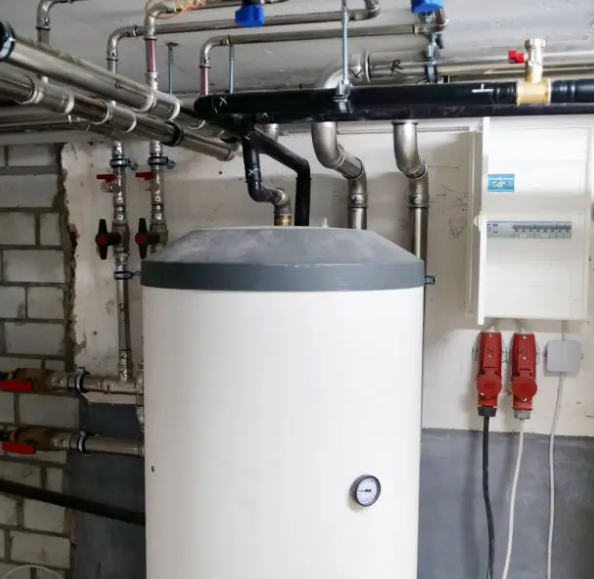
Why Venting and Combustion Air Matter Most
Of everything on a gas water heater, venting is what keeps the appliance safe. Watch for:
- Backdrafting — soot around the draft hood, condensation on top of the tank, or a burnt smell when it fires up.
- An orphaned heater — if a furnace or other appliance sharing the same flue gets removed or upgraded, the water heater can be left venting into a flue that no longer drafts properly. That situation needs a vent evaluation and often a switch to direct-vent or power-vent equipment.
- Sealed-up utility spaces — energy upgrades that seal and insulate a garage can accidentally starve an atmospheric unit of the combustion air it needs.
Every home running gas appliances should have working carbon monoxide detectors. If you ever smell gas, get everyone outside and call Southwest Gas from a safe distance before doing anything else.
Faults That Show Up Most Often
- Pilot keeps going out — usually the thermocouple, a dirty pilot assembly, or a blocked air intake screen.
- Burner cycling too fast or burning yellow — a combustion or venting problem that shouldn't wait.
- Recovery has slowed down — sediment insulating the burner from the tank water; a flush usually fixes it.
- Gas control valve gives out — common as units age, and typically the point where replacement gets discussed.
- Sulfur smell in the hot water — usually the anode rod reacting with bacteria in the water; see anode rod replacement.
For a symptom-by-symptom breakdown, see water heater repair.
Swapping In or Installing New Gas Equipment
Keeping the same fuel type is generally the simplest replacement when the gas line, venting and drainage are already sound. The job typically covers a sediment trap, a proper shutoff valve, pressure-tested joints, a new relief valve with discharge piping, and a draft test once the burner is running.
Weighing your options? See electric water heaters, tank water heaters and tankless water heaters, or start with water heater replacement.
Related Water Heater Services
Water Heater Repair
Pilot, burner, thermostat and venting diagnostics.
Water Heater Installation
Venting, gas supply and code details.
Tankless Water Heaters
High-output gas on-demand systems.
Tempe-Area Communities We Cover
Gas water heater work is available throughout Tempe and neighboring communities.
- Mesa, AZ
- Chandler, AZ
- Gilbert, AZ
- Scottsdale, AZ
- Guadalupe, AZ
- Queen Creek, AZ
- San Tan Valley, AZ
- Apache Junction, AZ
- Gold Canyon, AZ
- Fountain Hills, AZ
- Ahwatukee, AZ
Frequently Asked Questions
How long does a gas water heater last?
In Tempe's hard, mineral-heavy water and triple-digit summers, a gas storage tank typically runs 8 to 12 years, with annual flushing pushing units toward the longer end and scale buildup cutting it short.
Can I relight the pilot myself?
Most tanks have a lighting sequence printed right on the unit, and it's fine to follow it once. If the flame won't hold after that, stop trying and get it looked at rather than relighting it over and over.
What is an orphaned water heater?
It happens when a furnace or other appliance sharing the same flue is replaced or pulled out, leaving the water heater venting into a chimney that no longer drafts the way it should. A technician needs to inspect that vent path and usually recommends switching to power-vent or direct-vent equipment.
Is a power vent worth the extra cost?
It earns its keep in Tempe garages and utility closets with no usable chimney, a long vent run, or when you want the heater somewhere other than next to the existing flue. It also needs a nearby electrical outlet.
Why does my hot water smell like sulfur?
That smell usually comes from the anode rod reacting with bacteria naturally present in Valley municipal water. Changing the anode type often resolves it.
Will a gas water heater still run if the power goes out?
Standing-pilot, atmospheric-vent gas units keep heating water through a monsoon-season outage since they don't depend on electricity to fire. Power-vent and electronic-ignition models need line power for their blower or igniter and go cold until SRP or APS service is restored.
Request Help With Your Water Heater
Send a few details about your home and your current water heater. We will send you a quote with no obligation.
Unsure which service fits? Select Not Sure on the form and tell us what you're noticing — a lot of Tempe homeowners reach out before they know exactly what's wrong.
Request Your Free Tempe Water Heater Quote
Share a few details about your Tempe water heater and we will send back a quote with no obligation.