
Commercial Water Heater Installation in Tempe, AZ
Tempe Water Heaters provides commercial water heater installation in Tempe, AZ for homeowners and businesses across Tempe, Arizona and the East Valley. For a business, the hot water has to keep up during the busiest hour of the day without ever leaving customers, tenants or staff without service. Every project starts with a walk-through to measure actual demand at that property, then equipment, recovery capacity, utility hookups and backup are matched to what was found.
Commercial projects involve BTU/h input sizing, storage-and-recovery calculations, ASME-rated tanks, cascaded tankless banks with common venting, mixing valves with ASSE 1017 tempering, recirculation pumps with aquastats and balancing valves, and backflow and thermal-expansion control.
Request Your Free Tempe Water Heater Quote
Share a few details about your Tempe water heater and we will send back a quote with no obligation.
Commercial Hot-Water Planning Starts With Demand
A restaurant kitchen, a gym locker room, an ASU-area apartment complex and a hotel all draw hot water on completely different schedules. Counting fixtures isn't enough on its own; a proper installer maps out when demand peaks, what temperature needs to be delivered, how much storage is needed, how fast recovery has to be, and whether the property can tolerate losing one unit for a few hours.
Around Tempe specifically, that plan also has to factor in mechanical-room access, rooftop or exterior placement where equipment and vent caps sit through 110°F-plus summers, the building's existing Southwest Gas or APS/SRP electrical capacity, drainage, and how far the heater sits from the fixtures it serves.
| Property need | Installation priority |
|---|---|
| High simultaneous demand | Recovery rate, storage capacity and correctly sized distribution piping |
| Hot water is operationally critical | Staged or redundant equipment so one failure does not stop service |
| Long pipe runs | Recirculation design, balancing and insulation |
| Limited mechanical space | Service clearances, vent routing and modular equipment |
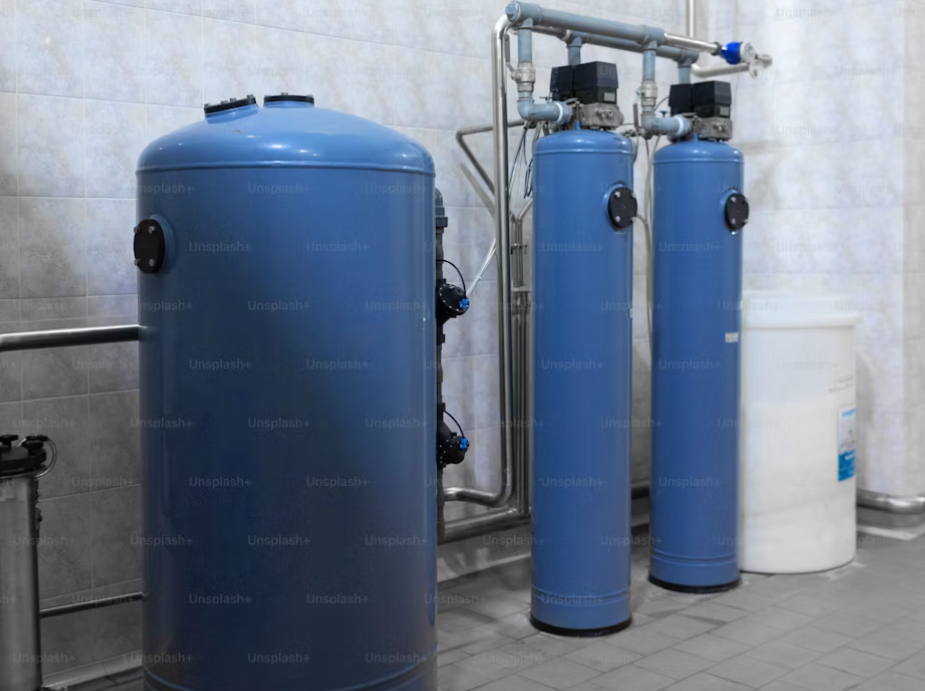
Commercial Tank, Tankless and Multi-Unit Systems
Commercial storage water heaters
Tank-style systems hold a reserve for those short, sharp rushes in demand. The right choice comes down to usable storage, burner or element output, how fast it recovers, and the outlet temperature required, not simply how many gallons the tank holds. See tank water heater options.
Commercial tankless systems
Banks of tankless units can be staged to ramp up or down with demand and, with isolation valves and the right controls, give a property built-in backup. Gas supply sizing, venting, condensate disposal, water quality and minimum flow rates all have to be designed as one system rather than bolted together piecemeal. Learn more about tankless water heaters.
Gas and electric equipment
Which fuel makes sense depends on what utilities already serve the building, how much hot water is needed, and the building's electrical or gas capacity. Review gas systems and electric systems before switching fuel types or equipment.
What a Commercial Installation Should Include
- A documented hot-water load and equipment schedule
- Verification of gas, electrical, venting, combustion-air and drainage capacity
- Accessible shutoffs, isolation valves and service clearances
- Temperature controls, mixing protection and recirculation balancing where required
- Pressure-relief discharge, drain-pan and thermal-expansion control appropriate to the system
- Startup testing, temperature verification and an operating handoff
Permit and inspection requirements vary by property and jurisdiction. The installer should confirm current City of Tempe or applicable Maricopa County requirements for the address and scope rather than relying on a generic checklist.
Plan for Maintenance and Future Repairs
Business equipment should go in with enough isolation valves and clearance that it can be drained and worked on without tearing apart the surrounding pipework. That means leaving room to pull burners, clean heat exchangers, swap controls or descale tankless units later. A solid maintenance plan cuts down on surprise outages; see water heater maintenance.
If the current system is already struggling, start with commercial water heater repair to figure out whether a focused repair or a planned replacement is the smarter operational call.
Related Water Heater Services
Commercial Water Heater Repair
Troubleshooting and repair planning for business systems.
Tankless Water Heaters
On-demand systems, sizing and descaling.
Gas Water Heaters
Commercial gas supply, combustion and venting considerations.
Water Heater Maintenance
Preventive service for reliable operation.
Tempe-Area Communities We Cover
Commercial installation requests are accepted throughout Tempe and nearby East Valley communities.
- Mesa, AZ
- Chandler, AZ
- Gilbert, AZ
- Scottsdale, AZ
- Guadalupe, AZ
- Queen Creek, AZ
- San Tan Valley, AZ
- Apache Junction, AZ
- Gold Canyon, AZ
- Fountain Hills, AZ
- Ahwatukee, AZ
Frequently Asked Questions
How is a commercial water heater sized?
Sizing weighs peak flow rate, storage capacity, recovery speed, delivery temperature, how fixtures are scheduled, and what downtime would cost the business. A site visit is essential because the type of business and its hours change the demand picture significantly.
Is it better for a business to run one large water heater or several smaller ones?
Staging several smaller units gives better turndown and keeps some hot water flowing even while one is down for service. A single large unit is simpler to install but becomes a single point of failure for the whole property. Which approach wins out depends on available space, utility capacity and how much risk the operation can absorb.
Are tankless water heaters a good fit for commercial properties?
It can, provided the system is sized to handle simultaneous draws and the building has the gas or electrical capacity, venting, condensate drainage and water treatment to support it. Multi-unit racks are a common solution where demand swings widely.
Will a commercial installation need a permit?
That depends on the equipment being installed, the property, and the jurisdiction involved. A qualified installer should confirm current City of Tempe or Maricopa County permit requirements for the specific address before work begins.
How long does commercial installation take?
Swapping in an identical replacement can often be done in a single day, while multi-unit systems, a fuel switch, new venting or utility upgrades usually mean the work gets phased over a longer schedule. Site access and inspection timing factor in too.
Can you schedule installation around our business hours to limit downtime?
Usually, yes. Staging equipment ahead of time, planning isolation points, and scheduling the physical work during slower hours all help minimize disruption. Talk through operating hours and the windows where hot water is critical before locking in a project date.
Request Help With Your Water Heater
Send a few details about your home and your current water heater. We will send you a quote with no obligation.
Unsure which service fits? Select Not Sure on the form and tell us what you're noticing — a lot of Tempe homeowners reach out before they know exactly what's wrong.
Request Your Free Tempe Water Heater Quote
Share a few details about your Tempe water heater and we will send back a quote with no obligation.